
From research to Davos: Bringing regenerative entrepreneurs into global conversations
In January, our co-investigator Delfina Fantini van Ditmar joined discussions on regenerative finance and innovation at the World Economic Forum Davos Climate Hub, bringing emerging insights from our project into conversations with leaders from business, investment, academia and civil society.
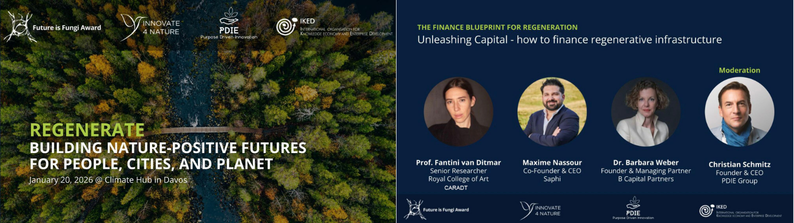
Regeneration is increasingly being discussed as a new paradigm for responding to today's interconnected ecological, social and economic challenges. While sustainability has largely focused on reducing harm, regeneration asks a more ambitious question: how can we restore, renew and strengthen the living systems that support life? It is an approach that recognises human-made environments as part of nature, rather than separate from it, and one that is beginning to influence thinking across design, finance, policy and technology.
Against this backdrop, the Davos Climate Hub offered a different kind of conversation to the one more commonly associated with the World Economic Forum. Moderated by Christian Schmidt, CEO of Purpose Driven Innovation Ecosystem (a B-Regen partner organisation), the sessions brought together a deliberately diverse mix of voices to explore what regenerative transitions might require in practice.
For B-Regen, it provided an opportunity to bring the experiences of regenerative designers and entrepreneurs into these conversations - helping to identify the systemic conditions that currently constrain their potential and informing future approaches to regenerative investment, collaboration and policy.
Throughout the day, speakers approached regeneration from different perspectives but arrived at remarkably similar conclusions.

Susanne Gløersen, founder of the Future is Fungi Award, highlighted the enormous potential of mycelium-based materials within the built environment. Carlos Álvarez Pereira, General Secretary of the Club of Rome, reminded participants that regeneration represents as much a cultural transformation as a technological or material one. Calling on participants to “free our minds” from the assumptions dominating the main congress centre in Davos, he argued that accelerating regenerative transitions requires reconnecting with nature, each other and time itself.
The conversation then turned to finance. Madiha Hasan, Executive Advisor at HYCAP, emphasised the importance of “patient capital” and “patient policy” as a counterpoint to today’s culture of short-term investment. She argued that regenerative innovation requires approaches that recognise longer timescales and create alignment between public and private actors across the wider system.
These reflections resonated strongly with what we have been hearing through the Becoming Regenerative project.
Drawing on emerging insights from our research with 78 regenerative ventures across sectors including fashion, biomaterials, products, the built environment and regenerative services, we highlighted four interconnected challenges shaping the conditions in which these entrepreneurs operate.
Working within infrastructures built for different futures
Many regenerative ventures are developing new materials, products and approaches that do not easily fit within existing industrial systems. Infrastructure, supply chains and production models have largely evolved around assumptions of standardisation, scale and predictability, creating tensions for innovations that are often more adaptive, place-based and connected to living systems.
Navigating standards and systems designed for conventional models
Existing regulatory and certification frameworks often reflect the priorities of established industries. While these systems provide important forms of accountability, they can struggle to recognise new forms of value and impact emerging from regenerative approaches, creating additional challenges for entrepreneurs seeking to bring their innovations to market.
Aligning policy with regenerative approaches
Many current policy frameworks have developed around sustainability and circular economy principles, but do not always account for the broader ambitions of regeneration. This can create gaps between the outcomes regenerative ventures seek to create and the mechanisms available to support and measure them.
Rethinking value, measurement and time
Regenerative innovation often operates on different timescales from conventional business models. Living systems evolve, adapt and generate value over longer periods, requiring new ways of thinking about success, investment and impact beyond short-term measures.
Together, these challenges reveal that regenerative transitions cannot be achieved through individual ventures alone. They require shifts across the wider systems in which entrepreneurs operate—including finance, policy, infrastructure and the ways we define and measure value.
This became one of the strongest themes to emerge throughout the discussions at the Climate Hub. Rather than focusing solely on increasing investment, participants repeatedly returned to the importance of building alliances across sectors. Researchers, entrepreneurs, investors, policymakers and civil society all have different roles to play in removing the barriers that currently hold regenerative innovation back. The challenge is not simply to fund better ideas, but to reshape the conditions that allow those ideas to take root.
For the Becoming Regenerative project, taking these insights to Davos was an opportunity to bring the experiences of regenerative designers and entrepreneurs into conversations that help shape investment and innovation agendas. Their work demonstrates that many of today’s barriers are systemic rather than individual, and that meaningful change depends on addressing the interdependencies between the systems that shape our economies.
Political and economic moments of uncertainty also create opportunities to imagine different ways forward. While genuinely regenerative perspectives may still be in the minority at global forums such as Davos, they deserve a place in these conversations.
Regenerative designers, researchers, policymakers and financiers cannot remain on the sidelines. Design, science and the humanities all have an important role to play in conversations about politics, culture and finance—not simply by imagining different futures, but by bringing evidence, practical experience and value-based thinking into the spaces where those futures are being shaped.
Read our Transition Design paper, which builds on these insights by exploring how design-led innovations are shaped by, and seek to transform, the wider systems in which they emerge.

